
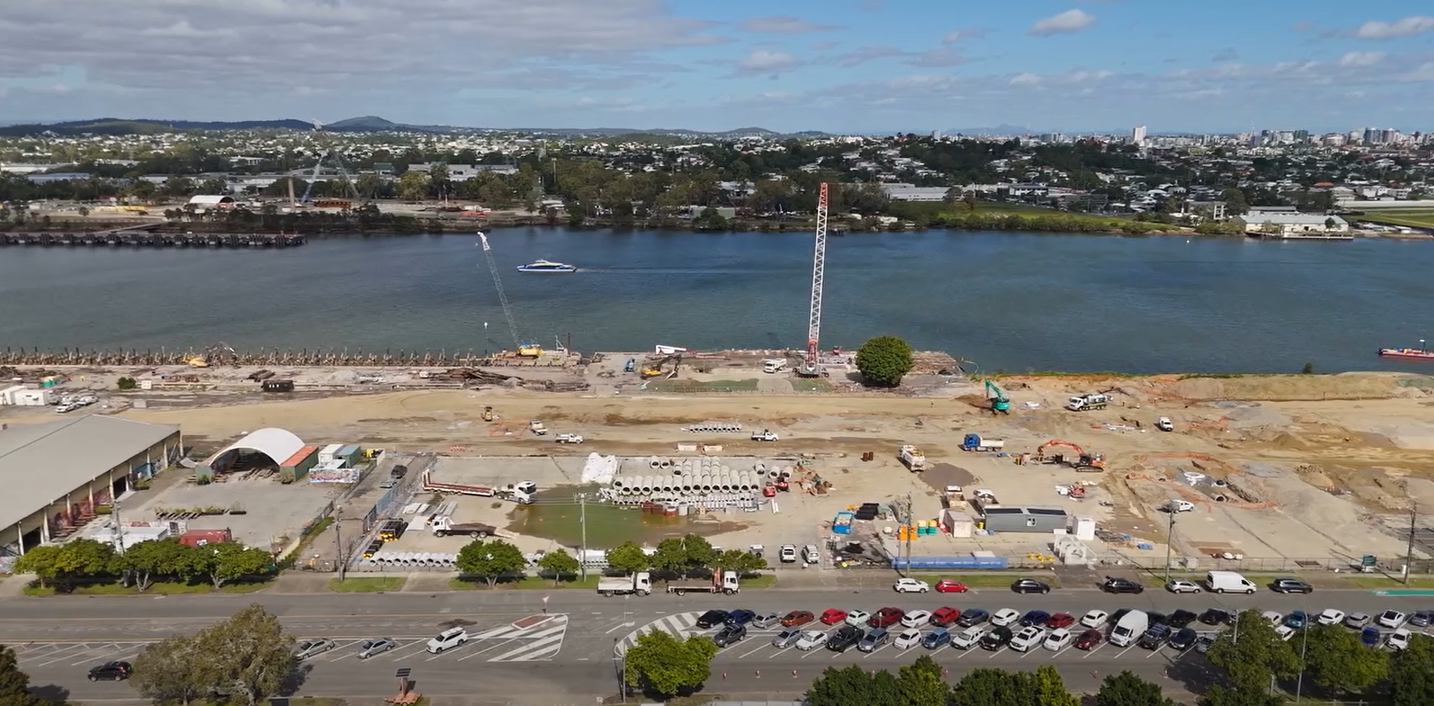
Hamilton Northshore: “Unsuitable” for a Stadium, but Fine for Thousands of Homes, a Hotel, Retail and Childcare
GIICA said Hamilton Northshore was unsuitable for a stadium because of transport, access, safety and existing development constraints. Yet the government is now pushing a major residential and commercial precinct there with 2,200 homes, a hotel, retail, medical services and potential childcare and education facilities.
That raises an obvious question: if these constraints were serious enough to rule Northshore out as a stadium location, why are they not serious enough to prevent thousands of people from living, working and raising families there permanently?
The GIICA 100 Day Review sets out the reasons Northshore Hamilton was rejected as a potential stadium site. Below, we compare those reasons directly with what the government has now approved and announced for the precinct and examine whether the same concerns are being applied consistently.
What GIICA’s 100 Day Review Actually Says About Northshore Hamilton
The report identifies Northshore Hamilton as one of five shortlisted locations considered for a new stadium.
GIICA acknowledged that a 60,000-seat stadium could physically be accommodated at Northshore. Despite that, it ultimately rejected the site overall, citing a series of challenges.
Those challenges included:
Land acquisition would be required.
A new rail extension and bus transit hub would be needed to provide an effective transport solution, with significant cost and program implications.
A stadium would impact the Northshore Hamilton Priority Development Area, which GIICA noted was already well progressed through planning and early works.
The site’s proximity to Brisbane Airport created potential event-related impacts and risks.
The site’s proximity to fuel storage north of the precinct created “potential safety implications”.
The site was considered less accessible than other locations because it is bordered by the Brisbane River and the golf course.
Northshore would not leverage existing government investment in Cross River Rail or Brisbane Metro and was less integrated into the wider public transport network.
Extending the rail network to Northshore would have broader network impacts, including constrained capacity, rollingstock availability and additional operating costs.
Now compare those concerns with what the government has announced for the same precinct.
Reason 1: Proximity to fuel storage and “potential safety implications”
Stadium rejection rationale: GIICA specifically cited the site’s proximity to fuel storage north of Northshore as presenting “potential safety implications”.
Residential development reality: The Queensland Government is now backing a precinct designed to accommodate up to 5,000 permanent residents across around 2,200 homes, together with a hotel, retail and commercial premises and potential medical, childcare and education facilities.
Children in a childcare centre may be present at the precinct day after day, year after year. Families will sleep there every night. Residents, workers and visitors will occupy the area permanently.
If proximity to fuel storage represented a safety risk significant enough to count against a stadium, how is that same risk now considered acceptable for thousands of permanent residents, including children?
The risk cannot simultaneously be serious enough to help disqualify a stadium, yet insignificant when the land is being promoted for homes, childcare, education and medical services.
Verdict: The dangerous goods argument is demolished by the residential and childcare approval. Either the risk was never sufficient to justify rejecting the stadium, or the government is now accepting that same risk for considerably more vulnerable and permanent uses.
Reason 2: Transport and accessibility
Stadium rejection rationale: GIICA said Northshore would require a new rail extension and bus transit hub to provide an effective stadium transport solution. It cited significant cost and program implications, poor integration with the existing public transport network and broader impacts from extending rail services to the precinct.
GIICA also considered Northshore less accessible than other sites because it is bordered by the Brisbane River and the golf course.
Residential development reality: The government is now planning for between 4,000 and 5,000 additional residents at Northshore, alongside a major shopping and commercial precinct, hotel, retail, medical services and other community uses.
That population will generate transport demand every day, not simply on event days.
The government has simultaneously committed $154 million over the next 16 months to prepare the precinct for development, including new internal roads and enabling infrastructure. Economic Development Queensland will also work with Transport and Main Roads on wider traffic management, with potential improvements including additional CityCat services and CityGlider bus services as the area grows.
In other words, the government has not concluded that Northshore’s transport and accessibility constraints make major development impossible. It has decided to address them.
A stadium and a residential precinct undoubtedly create different transport patterns. But that does not erase the central inconsistency: when Northshore was being considered for a stadium, the need for substantial transport investment counted heavily against the site. Now that the site is being opened for large-scale residential and commercial development, infrastructure shortcomings are being treated as problems to solve.
Verdict: Transport constraints were treated as a reason to reject Northshore for a stadium. For thousands of homes and a major commercial precinct, those same constraints are now being met with public investment, road construction and new transport planning.
Reason 3: Cost of infrastructure
Stadium rejection rationale: GIICA repeatedly pointed to the substantial additional infrastructure investment that would be required to make Northshore work as a stadium location, particularly the cost of extending rail and providing a bus transit hub.
Residential development reality: The government has now committed $154 million in public funding to prepare the Northshore sites for private development, including roads and enabling infrastructure.
That is a substantial public investment designed specifically to unlock residential and commercial development on land whose infrastructure requirements helped count against it as a stadium location.
The issue is not that $154 million would necessarily have delivered every piece of infrastructure required for a 60,000-seat stadium.
The issue is the different approach.
When public sporting infrastructure was being considered, the additional cost of unlocking Northshore was treated as a major disadvantage.
When private residential and commercial development is being facilitated, significant public expenditure on enabling infrastructure is described as an investment in the precinct’s future.
Verdict: Infrastructure cost was used as a reason to reject Northshore for a stadium, but public money is now being committed to overcome infrastructure constraints and enable private development. The objection has been applied selectively.
Reason 4: The Northshore Hamilton Priority Development Area (PDA) was already too far progressed
This may be the most revealing reason GIICA gave.
Stadium rejection rationale: GIICA specifically cited the:
“Impact on Northshore Hamilton Priority Development Area (PDA) site which is already well progressed through planning and early works.”
In other words, part of the argument against a stadium was not that the land could not accommodate one. It was that another development vision for Northshore was already underway.
Residential development reality: We can now see what that vision is becoming. Five private developers have been selected to deliver 13 towers across the 6.1-hectare site, containing around 2,200 homes for up to 5,000 residents.
The plans include a 50-room hotel, a 15,000-square-metre shopping and commercial hub, supermarket, retail tenancies and potential medical, childcare and education facilities.
GIICA did not simply conclude that Northshore was physically incapable of accommodating a stadium. It acknowledged that a 60,000-seat stadium could fit there, while listing disruption to the existing development plans as one of the reasons against proceeding.
Now that the scale and commercial value of those plans is becoming clear, the question becomes unavoidable: was Northshore rejected because it was genuinely unsuitable for a stadium, or because the government wanted the land preserved for residential and commercial development?
Reason 5: Airport proximity and accessibility constraints
Stadium rejection rationale: GIICA cited Northshore’s proximity to Brisbane Airport as creating potential event-related impacts and risks. It also said the precinct was not as easily accessible as other options because it is bordered by the Brisbane River and golf course.
Residential development reality: Neither of those geographical characteristics has changed.
The airport remains where it was when GIICA conducted its review. The river still borders the precinct. The golf course remains beside it.
Yet these constraints have not prevented the government from approving an intensive new community of thousands of residents, visitors and workers.
If these were serious enough to contribute to rejecting a major stadium, the government should explain why they are not considered similarly problematic for a dense permanent residential and commercial precinct.
Verdict: The physical constraints GIICA identified have not disappeared. What has changed is the proposed use of the land.
The Overarching Problem
The GIICA 100 Day Review presented its assessment as evidence-based and data-driven. Northshore Hamilton was rejected as a stadium site after GIICA identified transport, infrastructure, accessibility, safety and existing-development constraints. Today, those same constraints are apparently manageable.
The government is committing $154 million to enabling infrastructure. New roads will be built. Additional public transport options are being considered. Thousands of people will live permanently at the site. Retail, a hotel, medical services and potentially childcare and education facilities will operate there.
The development plans that GIICA itself cited as a reason not to build a stadium at Northshore are now being realised through major private residential and commercial development.
The only coherent explanation for this inconsistency is that the technical objections were not the real reason for the stadium rejection. Could the real reason be that the site was wanted for private development? Were the technical objections assembled to justify a predetermined conclusion?
If so, that is not how an independent review is supposed to work. And it is precisely the kind of conclusion that a parliamentary committee, the Crime and Corruption Commission, or a determined RTI applicant should be examining with the benefit of the board minutes, conflict of interest declarations, and pre-report government correspondence that the public does not currently have access to.
Northshore was ruled out. Other alternatives were ruled out. And ultimately the Queensland Government chose to put a new stadium in Victoria Park Barrambin - state heritage-listed public parkland with the destruction of mature habitat, pre-settlement trees (200+ years old) and public green space that decision entails.
The question is no longer simply whether Northshore Hamilton had constraints. The question is why those constraints were considered unacceptable when a stadium was proposed, but manageable when thousands of residential dwellings, a hotel, shops, medical facilities and childcare were proposed instead.